
|
The Peruvian Altum...
it's NOT an Altum, it's Scalare
By Michelle Ricketts/Dr. David Schleser

May 28,2000-The
Peruvian angels with the altum-like shape are from the Rio Nanay,
just outside of Iquitos, Peru. I am very familiar with the Rio Nanay angels
from Peru, as I lead tropical fish study and collecting trips to this region
every year, and will be going there again the month of July. In my travels
through Amazonian Peru and Brazil I have collected many angelfish - all
scalare. Like so many other fish angels vary considerably in appearance
within their large range.
Most of the angels that we catch in the Peruvian Amazon and its
tributaries develop quite a bit of green iridescence on the gill plate and
upper portion of the body as they mature. My colleague and friend Dr. Paul
Loiselle, author of numerous cichlid articles and books, and curator of
fishes at the New York Aquarium, has always been fascinated by this
coloration. Very different from the usual run of normal colored aquarium
strains. I have always wondered if these were the wild types used in
creating those iridescent greenish and blue aquarium strains.

About the Peruvian Angels with altum appearance... that was anecdotal
experiences gained from collecting them throughout a fairly wide area of
Amazonia, and seeing specimens from many locations in exporters'
facilities down there. The Nanay fish are a real puzzle, and I wonder if
they are really native to this river.
You see, in the 70's an exporter's facility was
flooded out and all his fish were released into the Nanay. This is
how discus reached this river that is upriver from their normal range that
ends at the Putumayo (the border of Peru with Columbia, 2 days boat ride
down river from Iquitos). In the 80's local tropical fish collectors started
catching discus in the Nanay descended from this accidental introduction. It
is possible that this very distinct strain of scalare might have reached
this river the same way. You realize that this is pure speculation. All
angels that I have caught nearby, but not in this river, look much more like
standard wild angels.
Another point to note is that the Nanay is a blackwater river (that is
why the discus did so well), and angels tend to be a whitewater or
clearwater fish, shunning the strongly acidic blackwater tributaries. Very
similar appearing angels have been imported regularly from Columbia, but I
do not know the locality of capture.

As far as I know there is no evidence that the various species of
angelfishes hybridize - in aquariums or in the wild. As to the number of "true"
species, that is still open to dispute. Some feel that what we call scalare
might be in fact a number of different but similar species. Since scalare is
found from Peru all the way to Belem, and in many of the Amazon's
tributaries, this might be found to be so. This is exactly what we are
finding in severum and festivum cichlids. Each of these former species have
now been broken up into several separate species (not subspecies). Eimeki is
generally accepted to be a synonym of scalare. The only place where altum
and scalare MIGHT possibly overlap in ranges is the middle Rio Negro.
Leopoldi is said to be Peruvian but I have never caught it. Kullander thinks
that this long bodied angel is the link between the genera Pterophyllum and
Mesonauta (the festivums). Cross breeding or selective breeding of local
variants is not the same thing as creating a hybrid. However, they should
never be released within the range of the species, since you have modified
local genetic makeup by cross breeding fish from 2 different populations.
You might be interested in learning that the notched forehead profile is
distinctly noted in the type description of scalare. According to Sven
Kullander, Dumerilii is a synonym of scalare, and what we call dumerilii is
really leopoldi.

Red Spotted Angelfish
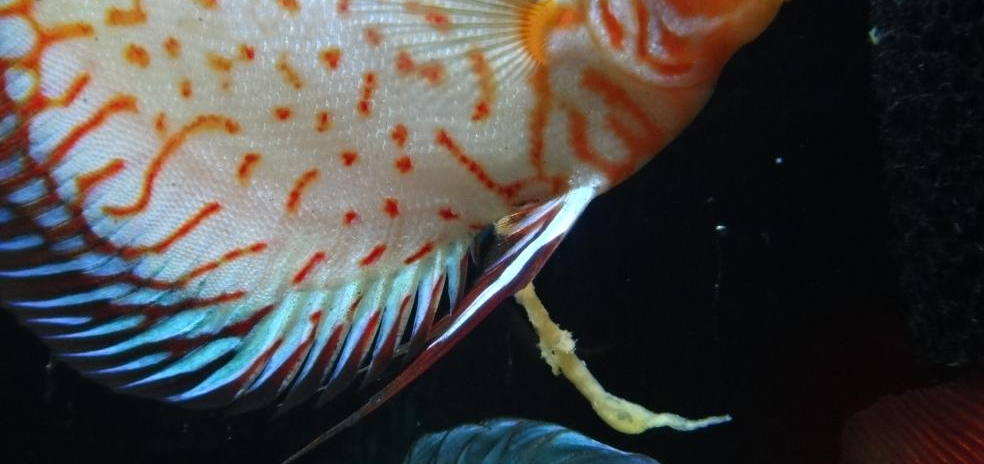
The red spots are found on most wild adult angels and are not due to
parasites. They fade in color while in captivity if the diet lacks carotene
precursors of the red pigment. This is a very similar situation to the
beautiful red spotting found on Peruvian green discus fish. If you see tiny
black dots on a wild angels fins and body, or small pin point size pimples,
these are most probably the encysted larvae of digenetic flukes. In order
for them to reach maturity the fish has to be eaten by the final fluke host.
This is usually a large water bird or mammal. They therefore can not
reproduce in an aquarium, do no harm, and eventually disappear. Wild silver
dollars are often similarly parasitized.
Regards,
David Schleser
Note: more information
on wild angelfish available at TBA |