|
Up the
Rio Negro 4
By Uncle Bill

The following morning we caught more varieties of apistos, lots of
cardinals, some hatchetfish, pencilfish and the variety of bleeding-heart
tetra found in the Rio Negro. It differs from the Peruvian type commonly
seen in our aquariums by being smaller and somewhat less colorful. All
that we collected are juveniles so I can't describe their adult size or
coloration just yet. They are quite an attractive fish and behave like a
school of pirana at feeding time.
 |
| A temporary
island in the Rio Negro. Within a month these trees will be
underwater as the river rises. |
Early in the afternoon, we left Igarape Zamulo and stopped at Ilha do
Urumari, a small island and holding station on our way to Igarape Maki.
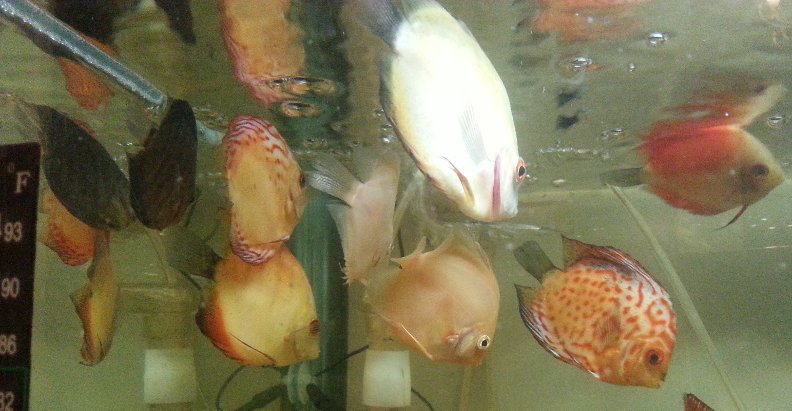
Here fishermen come to leave their catches of discus and angels in holding
pens to await a passing exporter's boat. It was here that I
"collected" my blue-headed Heckles along with a couple of dozen
altums and a lone P. leopoldi. The Rio Demeni holds all four of the
angles; P. scalare, altum, leopoldi and demerelii. After purchasing
various sizes of discus and the angles, we were off to Igarape Maki. If
this sounds like a whirlwind tour, it was.
Igarape Maki was only a "port of call". After breakfast we
headed for the Rio Demeni.
As we traveled up the Rio Demeni, Silas explained that there were no
discus on the left bank of the river, only on the right. For some reason,
the water quality differs from one side to the other. The banks were more
like cliffs climbing 20 or more feet from the river and were covered in
places with holes of 2 to 6 inchs in diameter. These were the nests of
assorted suckermouth catfish. Later, we caught several for dinner.
We tied up at one of the many fishermen's camping spots on the Igarape
Erete. I was about to get my hammock down for a much needed afternoon nap
when Silas announced that we were going fishing.
 |
| Discus live
under and way back in behind the branches that look like
shoreline. Actually, the "shoreline" is the tops of 20'
- 30' trees that will soon disappear with the coming heavy rains. |
Normally I would go with Crispin and my wife, Nancy, would be with
Silas. Today, Silas decided that I would accompany him and Nancy would go
with Carlos, his 11 year old grandson! It's one thing to enjoy a Sunday
afternoon on your local municipal pond in a row boat with a picnic basket,
happily waving to friends on shore. It is quite another to go into the
rainforest in a dugout canoe with an 11 year old boy as your wife's
boatman.
Once in the forest, all of my reservations immediately vanished. This
little boy was truly a child of the forest. Manning that canoe with the
expertise of his father, he never made the slightest noise while pushing
aside overhanging branches, cutting vines that blocked his way and
paddling all the while, much of the time with one hand. Occasionally we
would split up to explore different areas and their fishes. However far
apart we got, Silas and Carlos were in constant communication with each
other in hushed tones that were barely audible at the other end of the
canoe. It was amazing how the sound traveled across the water and through
the trees.
Back at the boat four hours later, we unloaded our catch of apistos and
assorted tetras and prepared for our last meal in the rainforest. It was
the usual gourmet's delight: fish, manioc and rice (that we had grown to
love) along with the last of the canned peaches. We had run out of coffee
that morning and the soft drinks and bottled water were long gone. We
finished dinner, untied the tether rope and began the allnight trip down
the river to Barcellos. It was time to return to "civilization"
Asher Benzaken had arranged a plane flight back to Manaus for us and
our fish. We arrived in Barcellos that morning and began packing the fish.
The plane was scheduled to take off at 2:00 P.M. (Amazon time). We had
enough time to purchase our tickets, pack the fish, get a taxi and catch
the plane.
At 1:00 P.M. we were ready and at the "airline" office. A
message came in on the short-wave radio: "Having landing gear trouble
- flight cancelled. Maybe tomorrow."
|

|
|
Our last
night on the Rio Negro. |
 |
No, not "maybe tomorrow." Not now. Not ever. We returned our
tickets, unpacked the fish into open plastic transport boxes, grabbed them
and our luggage and went to the ferryboat. It left the next day and we and
our fish spent the night on the ferry.
Since the return trip to Manaus is downstream, it takes a full day less
of travel time. Asher's man met us at the dock when we arrived Sunday
night and loaded our fish on his truck for the trip back to Turkys
Aquarium. There they would be properly packaged for their flight to San
Francisco. A hotel bed had never looked so good.
The next morning we took a taxi out to Turkys Aquarium, said our
"thank-yous" and "good-byes", picked up our fish and
were off to the airport.
23 hours later: "Hello San Francisco!" |