|

|
Up the
Rio Negro
By Uncle Bill

The sound of my alarm clock
began what was to be the most anticipated and completely satisfying
adventure that I have ever undertaken. My wife, Nancy, and I have fished
for the giant king salmon in Alaska's Kenai River, climbed the Mayan
pyramids in the Yucatan peninsula and fished for marlin off the coast of
Baja California. None of that compares with experiencing one of the last
untouched, and yes unspoiled, great rainforests: the Amazon rainforest.
Whatever you may have read, seen on film, or even dreamed will not prepare
you for the sheer and overwhelming beauty of this garden. It actually
brought tears to our eyes.
I'm getting ahead of myself, so let me tell you how this all began.
About four years ago, a friend of mine named Jeff Bickler, the manager of
Seahorse Aquarium in Redwood City, CA, suggested that I might find
"Dynamic Aquaria" by Walter H. Adey and Karen Loveland to be an
interesting read.
I read it from cover to cover and then began to study it. This book is
more of a graduate level textbook than your garden variety book about
tropical fish. Although I am usually hesitant to try new (at least new to
me) methods of fish keeping after more than 45 years in the hobby, I
converted two of my tanks to "algae scrubber" systems: one of 96
and one of 40 gallons.
These were to be research systems for the next fish that I hoped to raise
and here is where this odyssey begins.
 |
A
beautiful old building in Manaus. Because of the heavy amounts of
rainfall, Portuguese tiles were used instead of paint. |
For six months I had
been attempting, without success, to obtain some Altum angels of the
Venezuelan type, as opposed to the more commonly available Colombian
variety. I specifically wanted the V-type as their fins continue to grow
in relation to the body as opposed to the C-type. Supposedly, V-types can
reach a vertical size of up to 22 inches.
One afternoon, about three years ago, I was reading an article in
"Tropical Fish Hobbyist" written by Dr. Herbert Axelrod about
one of his many collecting trips to the Amazon basin. He referred to a
certain Adolph Schwartz of International Fisheries in Florida as having
been instrumental in organizing his expedition. Adolph is the son of the
famous collector, Willi Schwartz, founder of the Schwartz Aquarium in
Manaus, Brazil.
I contacted Mr. Schwartz and, six weeks later, 20 of the most beautiful
little dime size V-type Altums were ready for pick-up at the San Jose
airport. Today they are about 14 inches tall and are more beautiful than I
had ever imagined. Their bodies are covered with a gold and
aquamarine/metallic iridescence. I've never seen anything like them
anywhere. They are fed a homemade food and their only filtration is an
algae scrubber along with regular weekly 30-40% water changes. The pH is
kept between 4.25 and 4.5 with peattreated water. They have exhibited
spawning behavior as well as prominent breeding tubes but, as yet, no
successful spawnings have taken place.
 |
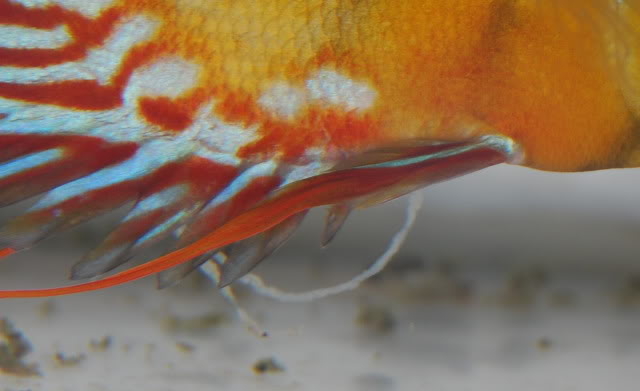
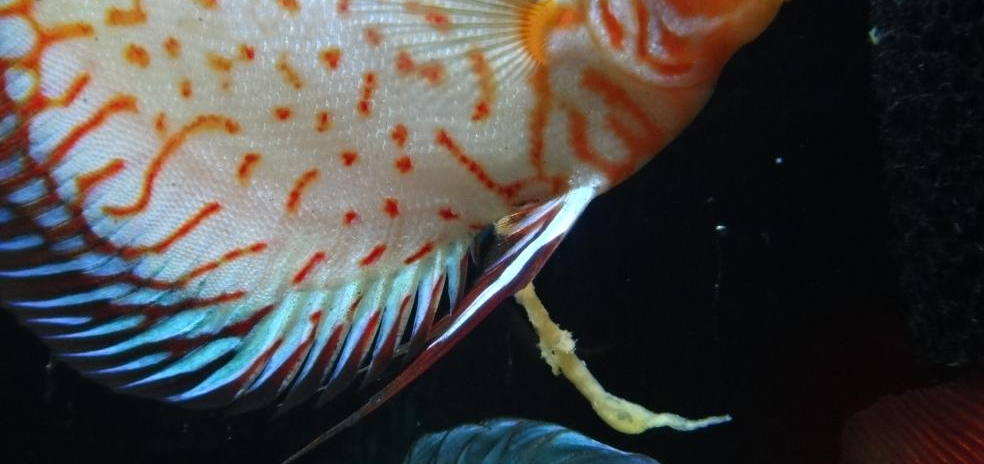
| One of
Uncle Bill's wild and rescued Alenquer Reds Symphysodon
aquafaciata axelrodi, a color morph of brown discus. Photo
1997 Richard Ng. |
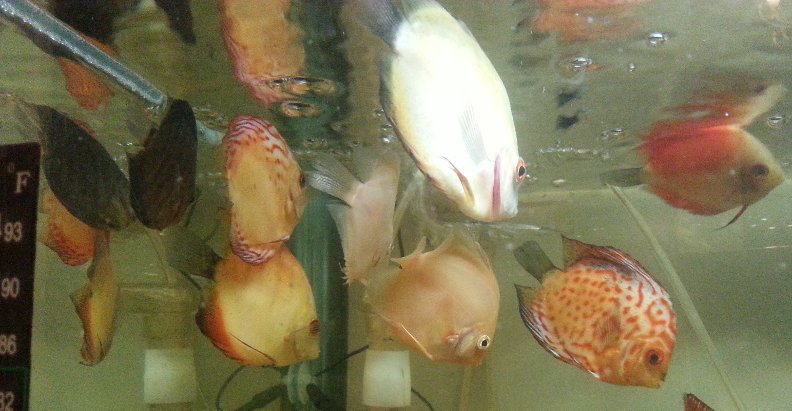
A year and a half
or so later, I happened into a local fish shop (not Seahorse Aquarium) and
spotted a tank with 24 juvenile wild discus. They were in absolutely
terrible condition. The owner proudly told me that they were from the
Mucuim River (wherever that is). Since I had a spare 20 gallon tank and
had bred discus before, I decided to see if it was possible to rescue some
of these poor little guys. I brought four of them home.
The only food that they had received was tubifex worms, their water was
hard and alkaline and the temperature was at 76 degrees F. Perfect
conditions for the destruction of wild, or for that matter any, discus.
They were acclimated over a period of about 1-1/2 hours to soft
peat-treated water, pH of 6.0 and a temperature of 86 degrees. Non-iodized
salt, 3/4 teaspoon/gal., was slowly added over a 2 hour period.
For the next two days, the salt content was increased to a total of 2.4
teaspoons/gallon and the temperature raised to 95 degrees F. These
conditions were maintained for 5 days and then the temperature was lowered
to 86 degrees F. over the next 48 hours. The salt concentration was
diluted by regular water changes.
The first feeding was on the third day and they began eating almost
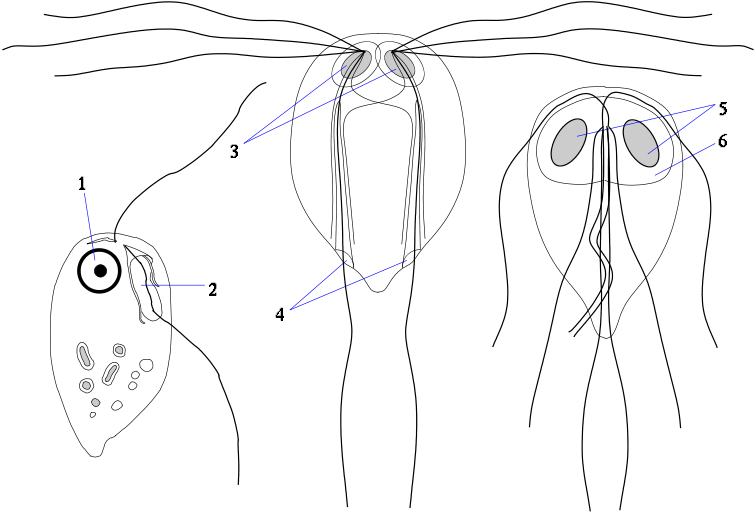
immediately. Their eyes were bulging, they had gill flukes, hexamita/spironucleus
and who knows what else.
Although I like modern medicine, I still believe that the less medication
the better.
After the first two weeks I had lost one fish but the others were showing
good color and putting on weight. Lord knows they couldn't afford to lose
any.
At the end of a month's quarantine, they were transferred to the 40 gallon
display tank and are today the most beautiful Alenquer Reds that you'll
ever want to see! Sometimes it pays to take a chance on some sick fish. Read
further in chapter 2 |